
Let’s say a QA reviewer flags missing OASIS discharge items after the visit has already been closed. The claim is pushed back by two weeks, even if the patient care has already been delivered.
This happens when documentation is finalized before required discharge elements are fully captured in the workflow.
This guide breaks down where that process falls short, what it costs in terms of delays and rework, and how to correct it before it reaches QA.
Key Takeaways

Discharge charting issues are often caused by breakdowns in sequencing, not the quality of care delivered.
Most documentation gaps build gradually during the episode and only become visible once QA reviews the completed chart.

Standardized templates, steady mid-episode checks and a simple pre-discharge review keep documentation aligned and claims moving.
What Discharge Charting Actually Requires Before an Episode Can Close
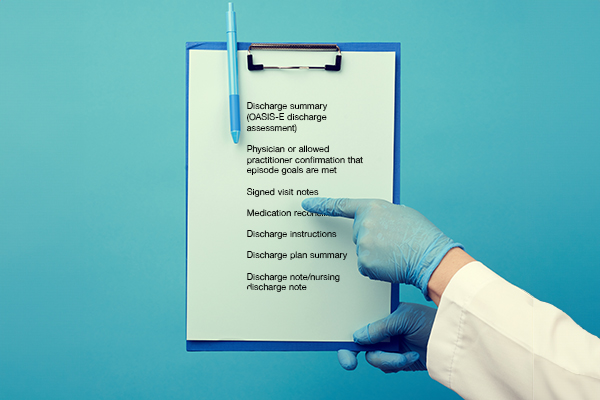
Discharge charting is the process of completing and closing all clinical documentation at the end of a home health episode. It covers everything from the final visit note to the Outcome and Assessment Information Set (OASIS) discharge assessment, physician orders and the discharge summary sent to the primary care physician.
If a single component is late or out of order, your claim gets pushed back, and your QA team absorbs the rework.
Here’s what complete discharge charting includes:
Component | What It Covers | When It Must Be Completed |
Discharge summary (OASIS-E discharge assessment) | Functional status, discharge plan, patient outcomes | Within 2 calendar days of the discharge date |
Physician or allowed practitioner confirmation that episode goals are met | Signed order confirming episode end; physician or allowed practitioner sign-off | Before episode closure |
Signed visit notes | All visit notes signed; hospital course documented; patient’s medical record updated | Before OASIS discharge entry |
Medication reconciliation | Discharge medications, medication changes noted | At or before the final visit |
Discharge instructions | Follow-up care, warning signs, follow-up appointments | Provided before the patient leaves |
Discharge plan summary | Continuity of care handoff, other healthcare providers notified | Sent to the primary care physician within 5 business days of the patient’s discharge |
Discharge note/nursing discharge note | Final clinical narrative: present illness resolution, patient’s condition at close | Same day as discharge visit |
Each component has a different owner. The assessing clinician handles the OASIS. The physician or allowed practitioner confirms that episode goals are met, and QA owns the final review.
Where Discharge Charting Breaks Down and How to Fix It
Incomplete discharge documentation usually comes down to the same four problems. Each one has a direct cost to your agency, in QA time, claim delays or audit exposure.
Gap | What It Costs Your Agency | How to Fix It |
Discharge summary responses don’t match visit notes; primary diagnosis inconsistencies | Outcome reporting inaccuracies; patient’s medical record misalignment; audit exposure | Cross-check visit narratives before OASIS entry; standardize discharge summary documentation review checkpoints |
Visit notes unsigned at episode close; missing details in discharge note | Blocks discharge summary creation; delays QA approval; documentation process backlog | Track unsigned visits 48 hours before discharge; assign clear ownership per clinician |
Medication reconciliation completed late; discharge medications not documented | Patient’s health continuity risk; compliance gap; patient care handoff breaks | Build reconciliation into the pre-discharge checklist; confirm before the final visit closes |
Physician or allowed practitioner orders unsigned before discharge summary submission | Episode can’t close; medical record incomplete; claim not ready | Verify order status before OASIS entry; flag outstanding orders to QA early |
Three things can close most of these gaps before they reach QA.
Standardize Your Discharge Summary Template Early On
Variation across clinicians is usually where incomplete discharge documentation starts. When every clinician works from the same discharge summary template, you reduce inconsistencies before they turn into QA corrections. The process doesn’t need to be complicated. It just needs to be consistent.
Every discharge documentation checklist should include:
- Discharge summary/OASIS M0906 completed and accurate
- All visit notes signed and reconciled, including the nursing discharge note
- Discharge medications documented and reconciled
- Physician or allowed practitioner discharge order signed
- Discharge instructions delivered; patient education documented
- Follow-up appointments confirmed and recorded
- Discharge plan summary sent to primary care physician or primary care providers within five business days of discharge
A complete discharge summary gives the next provider, the primary care physician or a clear picture of the patient’s condition at discharge.
Review Discharge Documentation Problems Before the Final Visit
Most discharge documentation issues don’t begin at close. They build up mid-episode and often go unnoticed until QA reviews the chart. A pre-discharge review 48 to 72 hours before the final visit gives your team time to correct issues before they delay the claim.
Check these before the final visit:
- Are all visit notes signed? Is the nursing discharge note drafted?
- Is medication reconciliation complete? Are discharge medications documented?
- Is the physician’s discharge order in and signed?
- Is the discharge plan ready to send to other health care providers?
- Are follow-up appointments scheduled and recorded?
Use Mid-Episode QA Review to Catch Gaps and Have Stronger Continuity of Care
Pushing QA to the end of an episode means corrections will pile up under the deadline. Mid-episode QA review identifies documentation gaps early and speeds up discharge summary creation at close.
A mid-episode QA review should confirm:
- Visit notes completed and signed within 24 hours of each visit
- Care plan goals are documented and updated as the patient’s condition changes
- Medication reconciliation stays current and consistent with physician orders
- Discharge plan drafted and updated as the episode progresses
- Relevant information from other health care providers captured in the record
When these are tracked throughout the episode, continuity of care stays intact and QA teams spend less time correcting preventable documentation gaps.
Why Discharge Charting Accuracy Affects Your Compliance and Survey Readiness
Accurate discharge documentation protects more than your claim. It reflects whether patient outcomes were captured correctly, whether the medical record holds together and whether your episode can be defended if it’s ever reviewed.
Area | Incomplete discharge documentation | Complete discharge documentation |
Outcome reporting | Inaccurate OASIS data skews patient outcomes; affects star ratings | Patient outcomes reflected accurately; supports valid benchmarking |
Audit exposure | Discharge summary gaps trigger ADR; medical record inconsistencies increase denial risk | Clean discharge documentation supports claim defense; reduces ADR burden |
Survey readiness | Missing discharge plan elements or late discharge notes create deficiency risk | Standardized workflows produce consistent, essential information surveyors expect |
How Documentation Support Improves Discharge Summary Completion at Scale
When your discharge volume is high, your QA team can miss things. An outsourced documentation team runs pre-close reviews, checks discharge summary entries against visit notes and tracks unsigned notes before the episode closes, so your internal team stays focused on clinical work and claims go out on time.
What an outsourced documentation team typically covers:
- Discharge summary review before episode close
- Cross-checking visit notes against OASIS discharge entries
- Tracking unsigned notes and outstanding physician orders
- Flagging medication reconciliation gaps before the final visit closes
- Confirming discharge plan delivery to the primary care physician within the required window
Remember: Tight discharge documentation means fewer corrections, faster claims and cleaner surveys. If the census is making that harder to hold, an outsourced documentation team keeps it consistent without adding to your headcount.
Frequently Asked Questions
Home health discharge charting includes the clinical documentation needed to close an episode properly: the patient discharge summary, the OASIS discharge assessment, signed visit notes, medication reconciliation, discharge instructions and the discharge plan sent to the primary care physician. Together, these records document the care provided and give the next provider a clear view of the patient’s treatment history from start to discharge.
Each component of discharge charting has a sequence. If visit notes are unsigned, the OASIS can’t be entered. If the OASIS isn’t complete, the patient discharge summary can’t be finalized. If the physician or allowed practitioner hasn’t confirmed that episode goals are met, the episode can’t close. One documentation gap can hold up the entire claim process.
A shared discharge summary template provides every clinician with a consistent structure to follow, regardless of caseload or experience level. It sets expectations for which key components are documented, in what order and by when. When every clinician follows the same structure, your QA team spends less time on corrections and more time on review.
The OASIS discharge assessment anchors the patient discharge summary. It captures the patient’s functional status and outcomes at close, which feeds directly into quality reporting and star ratings. When the OASIS is inconsistent with visit notes or the client’s treatment history, it creates a documentation gap that affects both the accuracy of the patient discharge summary and the care team’s ability to hand off ongoing care cleanly to the next provider.
When visit notes are signed on time, medication reconciliation is current and the discharge plan is drafted before the final visit, the patient discharge summary comes together without a last-minute attempt. Structured mid-episode reviews and a consistent pre-discharge checklist do more to reduce workload than any tool, because they keep treatment provided documented in real time rather than reconstructed at close. If volume makes that hard to sustain, an outsourced documentation team keeps the process consistent without adding to your headcount, supporting a smooth transition of care for every patient your care team discharges.