Let’s say two agencies have the same census, payer mix and staffing. One gets flagged for documentation gaps across six patients. The other walks out clean. The difference was that one of them was catching them internally, every week, before a surveyor did.
Quality Assurance and Performance Improvement (QAPI) is the system CMS requires every Medicare and Medicaid-certified home health agency to maintain. Agencies with a strong QAPI program catch documentation gaps early, protect their reimbursement and keep patient outcomes on track.
Key Takeaways

A weak QAPI program puts your claims, your staff and your patients at risk.
A strong QAPI program protects your reimbursement, your patients and your agency.

QAPI only works when your team acts on the data.
What Does QAPI Stand For and Why Do Home Health Agencies Get It Wrong?
QAPI combines two things that CMS expects every home health agency to run together:
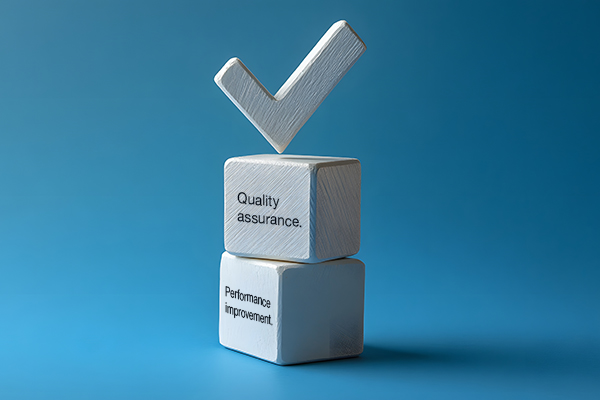
- Quality assurance. You’re checking that documentation meets standards, processes are followed, and your agency stays within regulatory requirements.
- Performance improvement. You take what you’re monitoring and turn it into corrective action.
Together, they form a comprehensive QAPI program that the Affordable Care Act mandated CMS to establish across health care facilities as a standard for health care quality management
Where agencies get it wrong
Agencies treat QAPI as a compliance exercise. They collect data, hold a quarterly meeting and then move on.
CMS expects:
- Continuous quality assessment of your documentation and care delivery
- Data-driven decisions tied to measurable quality improvement targets
- Structured QAPI initiatives with assigned owners and timelines
- Monitoring performance trends, not just pulling numbers at quarter end
Here’s a snapshot:
Component | What It Covers | What It Monitors | Failure Risk |
Quality assurance | Documentation validation, compliance checks | Standards are being met consistently | Survey deficiencies, audit exposure |
Performance improvement | Corrective action, trend-based interventions | Outcomes are improving over time | Repeated errors, no measurable gains |
What a Weak QAPI Program Costs Your Agency
A QAPI program that exists on paper but not in practice creates three specific risks:
Clinical Risk
Documentation gaps accumulate visit by visit and by the time you notice them, you’re looking at rehospitalization trends and patient care inconsistencies that affect your referral relationships.
Staffing Risk
Your clinicians are spending time on rework that a structured action plan should have prevented. The errors aren’t random; they’re recurring because no one is tracking them and closing the loop.
Revenue Risk
Without a correction cycle, coding errors recur. Weak quality assessment is usually behind it. Each one is a claim at risk and a reimbursement you may not recover.
Here’s how a weak and a strong QAPI program differ:
Area | Weak QAPI Program | Strong QAPI Program |
Clinical outcomes | Misaligned care plans, higher rehospitalization risk, undetected adverse events and unaddressed medical errors | Measurable patient outcomes, fewer care inconsistencies and improved safety in patient care delivery |
Staff workload | Reactive corrections, repeated documentation fixes and no clear action plans | Standardized review workflows, clear expectations and improved quality across teams |
Revenue performance | Coding errors, claim denials and declining patient satisfaction scores | Documentation supports claim integrity, stronger reimbursement and optimal quality billing |
Health care operations | Fragmented data collection, no corrective action loop, no quality improvement system in place | Data-driven approach for continuous quality improvement |
Where QAPI Implementation Breaks Down as Your Agency Grows
A QAPI program that works at low volume doesn’t always hold up when your agency scales.
Documentation Reviews Fall Behind When Census Outpaces Your Review Cycle
More visits mean more documentation. Meeting QAPI and regulatory requirements becomes more difficult as your review coverage thins out.
What happens:
- Audit coverage thins out as visit volumes increase.
- Documentation issues go undetected longer.
- QAPI initiatives lose consistency without a structured review cycle.
- Enhanced patient safety standards slip when oversight gaps widen.
What can you do:
- Set a minimum audit sample size that scales with census, not headcount.
- Assign a dedicated reviewer role separate from direct care responsibilities.
- Use health care compliance software to flag documentation gaps in real time.
- Build review checkpoints into your intake and recertification workflow.
OASIS Validation Happens Too Late to Drive Performance Improvement Projects
When OASIS validation happens after care ends, you lose the window to correct, retrain and drive ongoing improvement before the next claim is submitted.
By the time a clinician gets feedback, the visit is weeks old, and the pattern has already repeated. You see it in your clinical outcomes and health outcomes. A data-driven QAPI program catches it early.
What falls apart first:
- Coding inaccuracies go unaddressed until after claims are submitted.
- Clinician feedback arrives too late to change behavior.
- Performance improvement activities lose impact when feedback is tied to episodes that are already closed.
- Quality metrics show corrections that never translated to real change.
What you can do:
- Validate OASIS at the start of care, not at discharge
- Build concurrent coding review into your weekly workflow
- Use systematic analysis and analyze data trends to identify patterns before episodes close
- Strengthen your QAPI process by flagging OASIS discrepancies in real time through your data systems
Tracking Data Systems Without Acting on Them Is Not a QAPI Program
Looking at a dashboard every quarter is not a QAPI process. That is just recordkeeping.
What turns data systems into a working QAPI program is systematic analysis tied to action. Who owns the finding? What is the corrective action? When does it get checked again? A data-driven approach to track performance is what separates agencies that drive quality improvement from those that only collect data and get stuck.
What falls apart first:
- Metrics get reviewed but never assigned to an owner
- Corrective actions are discussed, but not documented
- QAPI initiatives stay at the leadership level and don’t translate to frontline practice
- No follow-through means the same findings surface every quarter
What you can do:
- Assign every finding an owner, a deadline and a follow-up date
- Document corrective actions inside your QAPI plan, not just in meeting notes
- Connect your performance improvement activities directly to the metrics driving them
- Schedule a 30-day check-in on every open corrective action
Key Elements of a Strong QAPI Plan for Home Health Agencies
Implementing QAPI programs effectively comes down to building the right structure and sticking to it.
These are the key elements every health care organization needs in place:
- Concurrent OASIS validation at every start of care
- Continuous data review tied to coding accuracy and claim submission
- Performance improvement plans with assigned owners, deadlines and follow-up dates
- Defining success metrics upfront, so your team knows what improvement looks like
- Leadership reporting that connects findings to action plans, not just dashboards
- A quality management system that scales with your census
QAPI efforts across home health agencies show that continuous improvement requires structure, not just intent. Agencies that build quality management into daily operations protect their patient outcomes and achieve optimal quality across their clinical and billing workflows.
Getting the right support
Even well-run agencies hit a ceiling.
Dedicated specialists can give your agency concurrent documentation review, coding accuracy oversight and scalable performance improvement plans without adding to your clinical team’s workload.
You get:
- Concurrent OASIS and coding review that protects high-quality care delivery
- Reduced administrative burden so clinicians focus on patient care
- Scalable coverage that grows with your census
- Specialists trained in QAPI regulations and medicaid services requirements
- Continuous improvement tied to corrective action
In home health, compliance isn’t the goal. Quality is. Compliance follows.
Frequently Asked Questions
QAPI stands for Quality Assurance and Performance Improvement. It’s the CMS system every Medicare- and Medicaid-certified home health agency must maintain. Quality assurance covers documentation validation and compliance monitoring. Performance improvement converts what you monitor into structured corrective action. Together, they form a comprehensive approach to managing care quality in your agency.
Yes. CMS requires all Medicare and Medicaid-certified home health agencies to maintain an active QAPI plan as part of their Conditions of Participation. This is not a one-time submission. It is a living document that guides your QAPI activities, tracks your improvement efforts and outlines your performance improvement initiatives with assigned owners and timelines.
Directly. A weak QAPI implementation lets coding errors and documentation gaps to remain uncorrected. Those errors affect claim acceptance, increase denial exposure and reduce reimbursement consistency. A data-driven QAPI program with structured QAPI activities and continuous data review protects your billing accuracy and supports sustained improvement in your revenue cycle.
QAPI is a leadership responsibility, but it runs at every level of your agency. Your administrator or executive director owns the program. Your clinical director oversees performance improvement initiatives and quality assurance processes. Frontline staff contribute through data collection, documentation accuracy and participation in corrective action cycles. Building a quality-focused culture means everyone understands their role in the QAPI process, including maintaining confidentiality of patient information and findings.
Start with a systematic approach to your existing workflows before adding new ones. The critical importance of QAPI isn’t doing more; it’s doing the right things consistently. Agencies that see meaningful improvements typically focus on three things: concurrent documentation review, structured corrective action loops and scalable data systems that surface issues early. When internal capacity reaches a ceiling, outsourcing QAPI activities to trained specialists provides health care providers with scalable support, reduces administrative burden and drives sustained improvement without adding headcount.