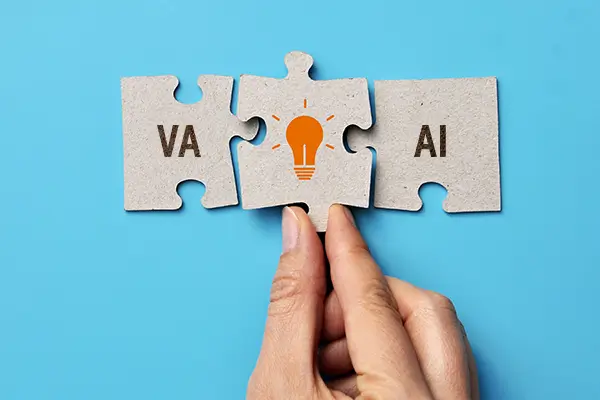
Every leader says they want to work smarter. But in 2025, smart means knowing when to lean on people and when to let machines do the work.
You don’t need more tools. It’s about getting the right kind of help.
AI executes. It learns from data, patterns and prompts.
A VA learns you.
That’s the real difference between automation and insight.
This article breaks down what works and doesn’t, and how people and automation intersect.
On this page
Key Takeaways
AI: AI streamlines operations and handles high-volume, data-driven work, but still needs direction and context to create real value.

VA: A skilled VA brings emotional intelligence, judgment and initiative, turning everyday execution into meaningful outcomes.

The edge: When both work in sync, you get efficiency with strategy, automation with insight and a business built to stay ahead.
The Real Divide: Automation and Critical Thinking
One’s a tool. One’s a teammate.
AI technology accelerates work and scales operations, but it runs on data and instructions. It’s powerful, but only within the limits of what it’s told.
A virtual assistant (VA), on the other hand, learns from you. They adapt to context, tone and priorities and understand why those tasks matter.
Here’s how they look in action:
Category |
AI (Artificial Intelligence) |
VA (Virtual Assistant) |
In Action |
|
Learns from |
Data, patterns and prompts |
You, your goals and your workflow |
AI can mimic your tone in writing, but a VA understands when and how to take action. |
|
Strength |
Speed and scalability |
Context and understanding |
AI can generate 10 reports in seconds; a VA knows which report your client actually needs. |
|
Trade-off |
No intuition or empathy |
Limited volume, unlimited context |
AI can’t sense urgency; a VA hears it in your voice. |
|
Improves through |
More data and repetition |
Deeper relationship and feedback |
AI sharpens with new data; a VA improves with every project you do together. |
|
Best for |
Repetitive or data-heavy work |
Complex, judgment-driven tasks |
AI drafts blog outlines; a VA finalizes tone, flow and relevance. |
The difference?
AI handles volume; a VA handles discretion and understanding.
What Artificial Intelligence (AI) Gets Right (and Wrong)
AI assistants provide speed, accuracy and scalability.
AI can:
- Automate workflows and streamline administrative tasks
- Manage data entry, scheduling and document organization
- Analyze vast amounts of data and deliver real-time insights
- Maintain consistency and accuracy across high-volume tasks
With machine learning and natural language processing, AI assistants operate more efficiently with minimal downtime.
AI assistance has been remarkably significant for businesses burdened by repetitive or routine tasks. A Marblism (2025) report shows that companies using AI tools in their daily operations achieve threetofivetimestheROI on automation by sharpening precision, reducing human error, and scaling work continuously.
But here’s where AI virtual assistants fall short:
- They execute, but they don’t interpret.
- They follow data, but they don’t understand context.
- They respond, but they don’t connect emotionally.
- They lack strategic thinking and human intuition.
AI can outpace any human VA, but it can’t outthink one.
That’s where technology stops, and people begin.
The Strength of a Virtual Assistant: Handling Complex Tasks with Human Insight
AI executes. Virtual assistants interpret.
If AI builds your foundation, a virtual assistant (VA) strengthens your business with context, judgment and adaptability.
VAs go far beyond administrative support; they bring human intelligence and insight, knowing what needs to be done in your workflows and when it’s best executed.
They bring:
- Critical thinking for complex tasks and fast, confident decision-making
- Emotional intelligence to keep human connection and trust alive in digital workflows
- Strategic thinking to align projects with business goals and data-driven outcomes
- Technical fluency to use and manage AI tools, CRM systems and workflow platforms effectively
- Adaptability to shifting context, tone and technology, knowing when to rely on automation and when to step in
- A personal touch that no AI system, no matter how advanced, can replicate
VAs excel in tasks requiring empathy, communication, discretion and judgment, which are spaces that AI can’t reach.
The future belongs to those who can blend human judgment with automated precision.
TIME, 2025 Tweet
VAs make this blend real, bringing intuition, context and emotional intelligence where automation stops.
Where AI Technology and VAs Work Best (and When to Use Both)
The clearest way to see the difference between AI and human VAs is in action: some tasks are designed for automation, others require human judgment, and the most effective setups utilize both.
Scenario 1: E-Commerce Operations
Lara (AI-focused): She deploys AI chatbots to manage customer emails, process orders and update inventory across multiple marketplaces. These repetitive, high-volume tasks are handled automatically, increasing operational efficiency.
The pain: A customer receives the wrong item, an order glitches and a refund request confuses the system. The AI executes flawlessly but can’t interpret context, tone or provide human interaction, forcing Lara to step in manually to protect customer satisfaction.
Scenario 2: Client-Facing Consulting
Devin (VA-focused): His VA schedules meetings, manages calendars and follows up with clients, while using AI tools to track project metrics from existing systems. Thoughtful handling of strategic tasks and personalized interactions keeps projects on track and relationships strong.
The pain: Routine work still consumes hours: sending reminders, compiling recurring reports and tracking deadlines. Even a skilled VA can’t fully keep up with high volumes, and some tasks could be automated to complete work faster, leaving Devin to consider a smarter balance between speed and judgment.
Scenario 3: Marketing & Analytics
Sam (AI + VA): He uses AI to automate reporting, analyze real-time data and complete simple tasks like analytics summaries. The VA interprets insights, adjusts messaging and ensures campaigns hit the right tone for clients.
The pain: AI generates reports and summaries quickly, but without human interaction or context, the results feel flat and generic. This is where the VA helps, interpreting nuance, refining tone and ensuring campaigns stay human, relevant and responsive.
Here’s what it could look like for your business and the results when you combine both.
Business/Work | AI Virtual Assistant Role | Human Virtual Assistant Role | When Combined |
E-commerce | Automates hundreds of order confirmations a day | Handles tens of returns and tricky requests/week | Fast orders + ~90–95% customer satisfaction |
Marketing | Drafts 30–50 email templates and weekly reports | Refines copy, schedules posts | Data at scale + ~15–20% higher engagement |
Project Management | Tracks hundreds of tasks and deadlines per month | Coordinates teams and priorities | Tasks done + ~20–30% faster project completion |
Client Relations | Sends 100–200 follow-ups and reminders per week | Resolves sensitive client issues | Routine handled + stronger client trust |
Administrative Support | Manages 100–150 calendar entries and reminders per month | Prepares reports and adapts schedules | Repetitive done + ~10–15% productivity boost |
Here are our trusted AI tools to make your work easier:
- Zendesk, Intercom, Google Assistant – Customer Service
Automate routine customer queries, order confirmations and FAQ, allowing your VA to handle complex requests and high-touch interactions.
- Asana with AI, ClickUp AI – Project & Task Management
Track deadlines, monitor workflows and surface priorities across your existing systems, allowing your VA to coordinate teams and manage nuanced tasks effectively.
- Tableau with AI, Looker – Data & Analytics
Summarize real-time data, analyze trends from multiple data sources and generate reports, so your VA can interpret insights and make strategic recommendations.
- GrammarlyGO, Jasper – Email & Content Automation
Draft templates, schedule campaigns and handle repetitive communication, letting your VA refine tone, context and messaging using AI’s key features.
Designing the Hybrid Advantage
The future isn’t a human or machine, it’s both.
Together, they keep teams ahead and businesses growing.
When designed well, hybrid systems let leaders focus on impact and output.
Here’s how hybrid systems improve your business outcomes:
- Operational efficiency. Machines automate workflows, track progress and reduce errors.
- Task complexity. VAs focus on judgment-heavy work, applying context and strategy where machines can’t.
- Analyzing data. AI processes large volumes instantly; VAs interpret, prioritize and decide on next steps.
- Human touch. Decisions requiring empathy, nuance and relationship-building remain in human hands.
- Business growth & productivity. Combining AI speed with human insight multiplies output while maintaining quality and strategic focus.
VA as a Strategic Partner
You’ve seen how AI and people can work together.
Now, consider what happens when you transform your VA into a true strategic partner.
- Revenue and growth
When you delegate high-value work, you open space for strategy and client relationships. When you manage them effectively, you can get 10+ hours back every week and see returns up to 279%.
- Operational efficiency
Studies show leaders regain 10+ hours weekly, improving productivity by 28% and cutting task turnaround time from 28+ hours to just 17.6 hours.
- Strategic longevity
VAs who oversee AI tools and workflows can reduce operating costs by 25% to 45%. According to industry data, 72% of VA partnerships last over six months, and nearly half of clients hire a second VA within a year, signaling sustained trust and scalability.
AI may fuel efficiency, but as a strategic partner, your VA gives direction, clarity and impact. And that’s the real edge of modern leadership, intelligence with intent.
Frequently Asked Questions
Think of AI assistants as systems built to execute predefined tasks. They analyze vast amounts of data, handle routine or repetitive tasks and deliver results with speed and precision.
But they lack context, empathy and discretion, which data alone can’t teach.
On the other hand, a human VA can perform complex tasks that require emotional intelligence, judgment and human intervention. They understand context, read between the lines and adapt to changing business needs while maintaining security protocols and personal trust.
Key difference: AI runs on machine learning and data-driven patterns; a VA runs on human connection and critical thinking.
Use a VA when your work demands nuance, empathy or critical thinking.
If a task:
- Impacts clients or teams directly (calls, onboarding, follow-ups)
- Involves decision-making or discretion
- Needs a personal touch or real-time context
Use AI for routine, repetitive and predefined tasks such as:
- Automating workflows
- Organizing emails or schedules
- Analyzing real-time data from multiple data sources
- Handling high volumes of structured information
Let AI handle the noise so your VA can focus on what moves the business forward: strategy, relationships and growth.
They don’t replace each other; they enhance productivity by combining their strengths.
- AI tools (like Google Assistant, ClickUp AI or CRM automations) automate workflows, track progress and suggest actions based on data.
- The VA ensures data accuracy, applies human judgment and manages security protocols to protect client and company trust.
- Together, they create a cost-effective, scalable and adaptive system that allows businesses to stay focused on growth.
Bottom line: AI helps you move faster and your VA helps you move smarter, allowing your business to stay ahead in an evolving landscape.